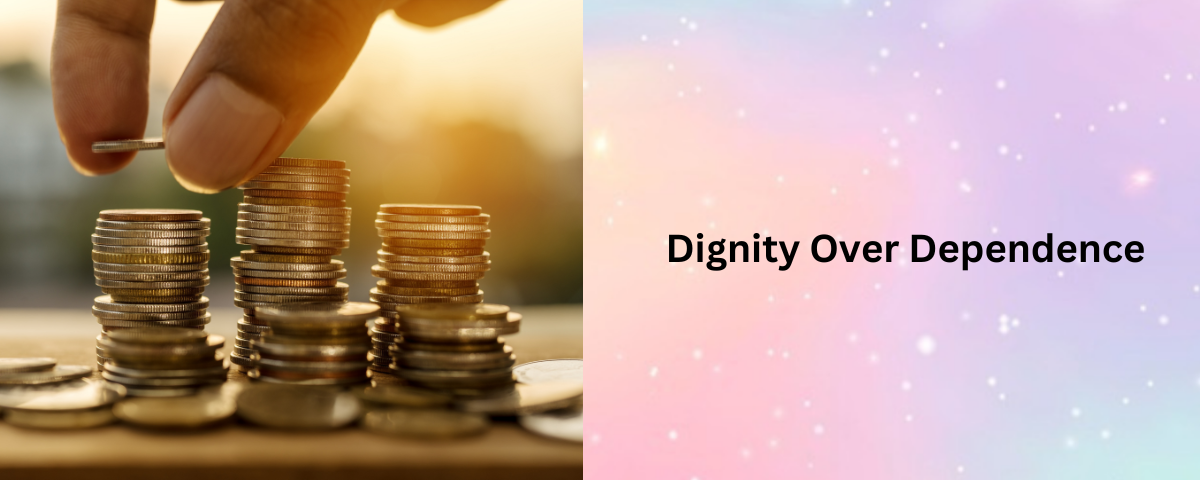
Dignity Over Dependence
19th October 2026
“I am not good with money” is a choice, not a personality
trait.
Financial literacy is learnable. Financial excuses are
optional.
After choosing to take a break in my career, I distanced myself from
current affairs, professional growth, and financial planning.
Savings, investments, and budgets felt like a distant world.
All I did was mothering—and I don’t regret a single moment of it.
But looking back, there was still room for me to learn and grow
alongside motherhood.
When I started stepping out and socializing after three years, I
often felt left out. During a catch-up with a friend I hadn't seen
in eight years, I casually said,
“I am just not good with money.” She looked at me and gently
pointed out that saying that wasn't something to brag about or wear
as a badge of honor. I smiled and passed it off in the moment, but
internally, it shook me.
The truth was, I didn't have the guts to face financial literacy. I
wasn't earning anymore, and I hadn't saved much from my 4.5 years in
corporate. My inner monologue rationalized:
“What am I going to do with all this financial information
anyway?”
My husband was always generous and made sure I had funds whenever I
needed them.
Little did I know, I was completely wrong.
Earning or not, money or no money—you still need to understand it.
1. If you plan to earn one day, you must know how to save, protect,
and multiply what you make.
2. If you aren't earning, your awareness allows you to be an active,
valued voice in your family's long-term decisions.
Lessons on Survival vs. Security
Growing up, money was rarely discussed at home. Times were tough; my
parents were focused on basic survival, leaving little room for
savings or investments.
It was my husband who gave me a fresh perspective: If you earn less,
scale down your needs, but save no matter what.
When you live paycheck-to-paycheck without a buffer, any sudden
emergency forces you to borrow or take loans at exorbitant interest
rates—costing you far more in the long run. Limiting unnecessary
desires today to build an emergency fund tomorrow isn't restriction;
it's protection.
Breaking the Patriarchy of Silence
Patriarchy has a subtle way of dividing financial roles: women are
often expected to stretch limited funds to run the day-to-day
household, yet they are systematically excluded from crucial
wealth-building decisions. What an irony.
Fortunately, things are changing. Educated, earning women are
increasingly taking charge of their financial destinies. But to the
women who still retreat into a cocoon when money matters are brought
up: Please don’t.
You don't need to be a financial expert to sit at the table. Even if
you don't have a firm opinion yet, be an active, observant
participant whenever your family discusses finances.
The Ultimate Lesson: Have Your Own Money
If there is one thing I want every woman to take away from this, it
is this: HAVE YOUR MONEY.
No matter how small or large the amount, have money that belongs
strictly to you. This isn't about greed; it's about dignity.
A woman’s confidence multiplies tenfold when she knows how to earn,
hold, and grow her own money. Having lived through both phases, I
know how miserable it feels to constantly ask for money, or to
quietly sacrifice your wishes just to avoid asking. Sacrificing
leaves us resentful, and total financial dependence hands over
control of our lives to someone else making us a pawn.
I don't hold a degree in commerce or finance, and these pointers
aren't packed with complex jargon. These are simple lessons I
learned the hard way—and my only hope in sharing them is that you
don't have to learn them the hard way too.
This post is a part of Bachat & Beyond Blog Hop hosted by
Sukaina Majeed and
Manali Desai
under the #EveryConversationMatters Blog Hop Series powered by
authors
Suruchi Hirawat
and
Harsh Soni.
Comments