Empathy
7th April 2026
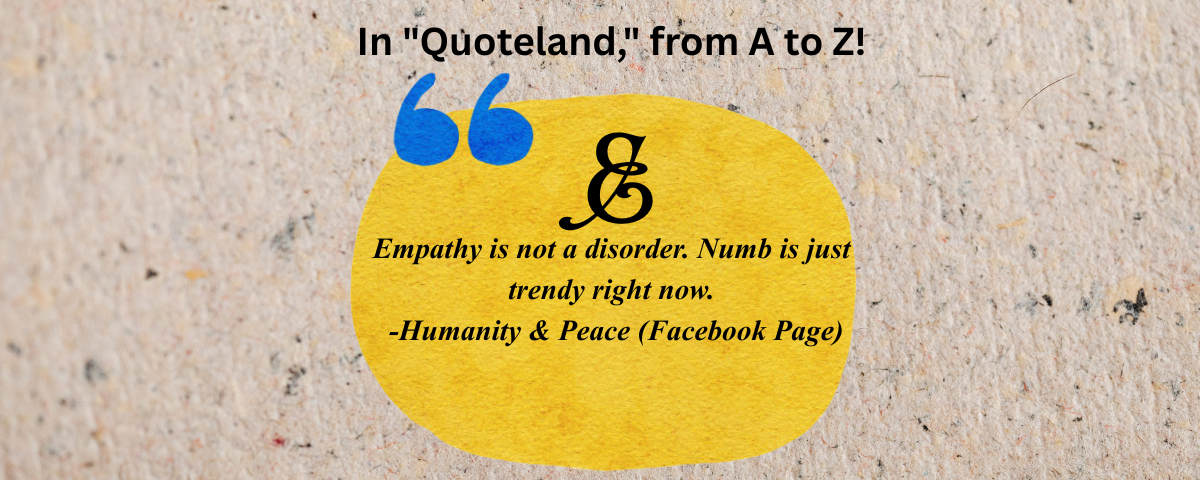
The day I had decided I would write quotes in A to Z, I was sure E would be for empathy, but I did
not have the idea of which quote exactly would go there. The moment I saw this powerfully framed
quote, there was no second thought.
There is a strange cultural shift where being "unbothered" or "savage" is often celebrated as a sign
of strength, while actually feeling the weight of things is dismissed as being "too sensitive."
When empathy is viewed as a burden or a glitch in the system, people begin to prioritize emotional
distance as a defense mechanism. However, "numbness" as a trend often acts more like a mask than a
genuine state of being—it's usually just a response to burnout or overstimulation.
True empathy actually takes a significant amount of mental and emotional resilience. It’s much
harder to stay open and perceptive in a world that feels increasingly loud than it is to just tune
it all out.
If numbness is a trend, then empathy is a timeless necessity. Trends eventually fade when people
realize that a "numb" life is also a flat one—void of deep grief, yes, but also void of the heights
of joy, connection, and purpose.
We must stop apologizing for our capacity to feel. The ability to be moved by a story, to be pained
by an injustice, or to be overjoyed for a stranger’s success is not a glitch in our programming. It
is the very thing that makes us human.
There is a profound bravery in remaining perceptive in an era that encourages us to be blind. To
stay open-hearted in a cynical world is a radical act of defiance. If numbness is a trend, then
empathy is a timeless necessity. Trends eventually fade when people realize that a "numb" life is
also a flat one—void of deep grief, yes, but also void of the heights of joy, connection, and
purpose.
We must stop apologizing for our capacity to feel. The ability to be moved by a story, to be pained
by an injustice, or to be overjoyed for a stranger’s success is not a glitch in our programming. It
is the very thing that makes us human.
The trend of being "unbothered" is a temporary shelter. True strength is found in those who have the
resilience to stay soft in a world that tries to harden them. Empathy is not a burden to be cured;
it is the light by which we find our way back to each other.
The "Self" Check
Before we can connect with others, we have to understand our own emotional capacity.
◉ Am I listening to understand, or listening to respond? Often, we aren't empathizing; we are just
waiting for a gap in the conversation to offer our own perspective.
◉ What is my "Emotional Bandwidth" today? Empathy requires energy. Asking this helps you distinguish
between being "numb" by choice and being "exhausted" by circumstance.
◉ Do I judge my own sensitivity as a weakness? If you view your own feelings as a "disorder," you will
naturally struggle to validate the feelings of others.
Perspective Shifting: The "Other" Check
These questions help bridge the gap between your experience and someone else's.
◉ What part of this person’s story am I missing? We usually empathize based on what we see, but the
most important details are often what people hide.
◉ If I had their history and their fears, would I react differently from them? This removes the "I
would never do that" bias.
◉ Am I empathizing, or am I projecting? Projection is feeling what you would feel in their shoes;
empathy is understanding what they are feeling in their shoes.
Practical Application: Moving to Action
Empathy is a feeling, but compassion is a verb.
◉ How can I make this person feel seen without trying to "fix" their problem? Often, empathy is simply
about witnessing someone's reality without offering a solution.
◉ What is the smallest act of kindness I can do right now that requires no "trendiness"? How can I
protect my empathy so I don't become cynical? This involves setting healthy boundaries so you can
stay "soft" without being destroyed by the weight of the world.
This post is a part of Blogchatter A2Z Challenge 2026.
Comments