Humbling Lines
10th April 2026
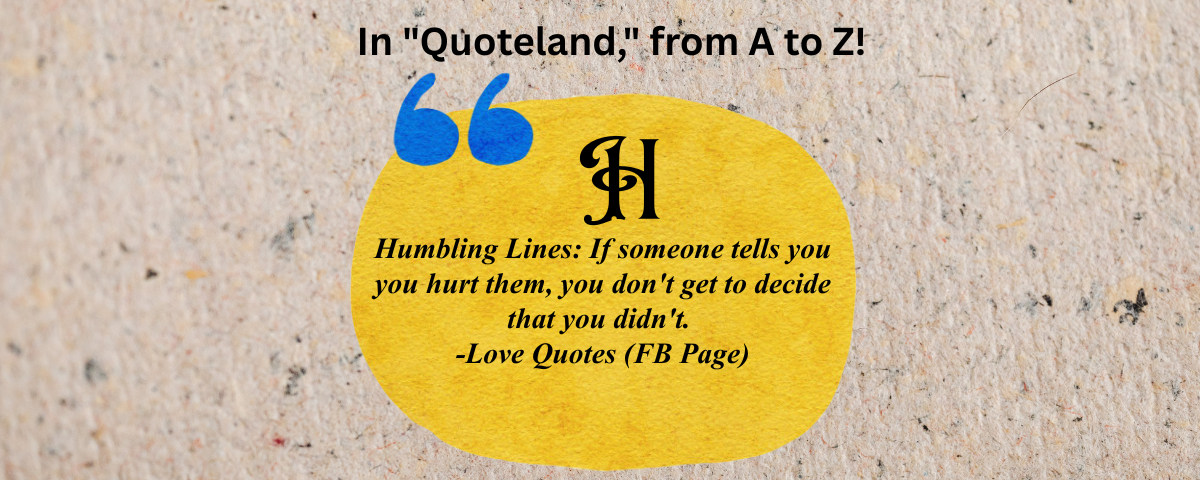
Humbling Lines: If someone tells you you hurt them, you don't get to decide that you didn't.
We keep listening, "We are all unique", "We are different in the way we feel and react to things."
Yet, whenever we come across this statement from others, "You hurt me", we do not hold back from
giving justification for what we did, ironic, right?
Where does that urge to be clean and blameless come from, then? Why don't we remember that what we
feel may be different from what they feel, and the right thing to do is to respect their feelings,
too? When someone expresses that they have been hurt, the immediate human impulse is often
defensive—a reflex to protect our self-image as a "good person."
This small, tiny thing was taught to me by my son when he was 7 (soon to be 11!) It was about the
way I corrected him after he made a mistake.
He put it simply, and I tried to defend, but his expression and opinion still remained the same. At
that time, I felt he was being adamant. It was only after I read this quote that I understood that
only he has the right to decide how he feels about a certain thing/incident.
Pain is a subjective experience, not a debate. If a person steps on another’s foot, the person who
was stepped on is the only one qualified to report the sensation of pain. The person standing on the
foot cannot use their intention—"I didn't mean to step on you"—as evidence that the other person is
not actually hurting.
In the realm of emotions, this logic remains the same. Everyone carries a unique set of "nerve
endings" shaped by their history, temperament, and past traumas. What feels like a lighthearted joke
to one person may feel like a sharp jab to another. To tell someone they aren't hurt is to attempt
to colonize their internal reality with your own.
On the other hand, when we are told we’ve caused harm, we often respond with "But that’s not what I
meant." While intent is important for context and reconciliation, it is secondary to the immediate
reality of the harm caused. Focusing solely on intent is a form of emotional gaslighting. It
suggests that the victim’s feelings are only valid if the "offender" permits them to be. By deciding
that we didn't cause hurt because we didn't intend to, we effectively shut down the path to
resolution and prioritize our comfort over the other person’s healing.
True accountability requires the humility to sit with the discomfort of having caused pain. It
involves a shift from a defensive posture to a curious one. Instead of litigating the facts of the
event, accountability asks: "I didn't realize that would affect you that way; can you help me
understand so I don't do it again?"
This doesn't mean you must agree with the other person’s logic or that you are a "bad" person. It
simply means acknowledging that your actions had an outcome you didn't foresee. And hence, this
quote serves as a fundamental rule of emotional intelligence and interpersonal accountability.
This post is a part of Blogchatter A2Z Challenge 2026.
Comments