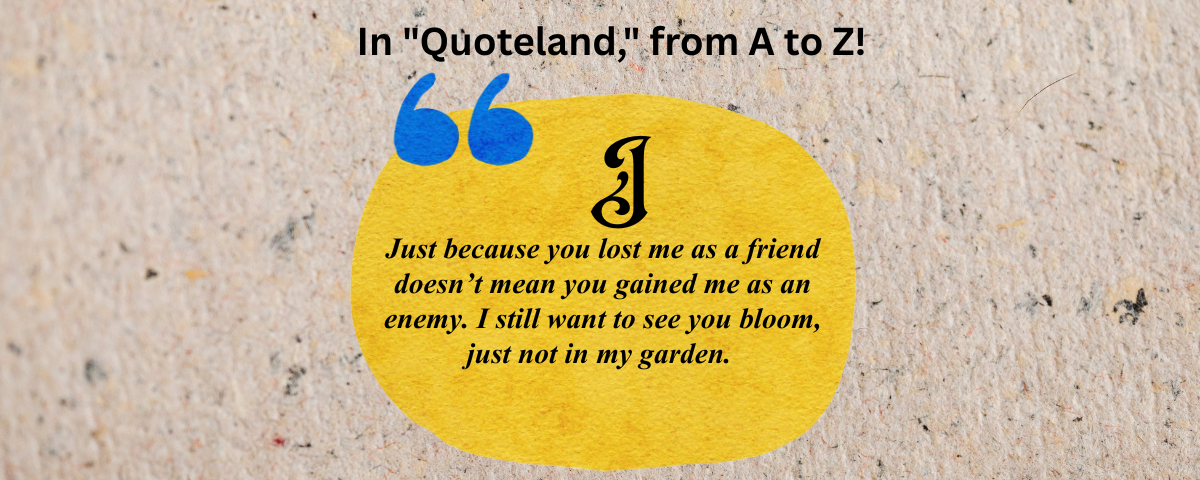
Just because
12th April 2026
The end of a friendship is often framed as a binary choice: you are either an ally or an adversary.
However, this quote introduces the concept of benign distance—a state where the connection
has
dissolved, but the ill-will has not taken root. This perspective is a hallmark of emotional
maturity, prioritizing personal boundaries over the exhaustion of a grudge.
The "garden" in this metaphor represents our most intimate emotional space. It is the soil we tend
with our time, trust, and vulnerability. When a friendship ends, it usually means the "environment"
of that garden is no longer conducive to mutual growth. Perhaps the soil turned toxic, or perhaps
the two plants simply required different amounts of light and water to survive.
Choosing to remove someone from your garden is an act of self-preservation, not necessarily an act
of war. It is an acknowledgment that while two people may be "good" in isolation, they are no longer
good together. By establishing this boundary, you aren't wishing for the other person to wither; you
are simply stating that you can no longer be the person who waters them.
Society often pressures us to justify the end of a relationship by vilifying the other person. If
they aren't friends, we feel we must portray them as villains to justify our decision to leave.
However, maintaining an "enemy" requires an immense amount of emotional energy. To hate someone is
to stay tethered to them, constantly checking their progress to ensure they aren't doing better than
you.
By wishing someone well "from a distance," you reclaim that energy. You choose a middle path:
Neutrality: You no longer carry the burden of their problems.
Detachment: Their success no longer feels like your loss.
Grace: You acknowledge their humanity without needing to participate in it.
There is a quiet power in wanting someone to succeed even after they have hurt you or after you have
grown apart. It reflects an understanding that the world is better off when people "bloom,"
regardless of whether we are there to witness it. This mindset recognizes that a person’s value
doesn't decrease just because they are no longer a fit for your life.
Seeing someone "bloom in another garden" is the ultimate sign of closure. It means you have moved
past the pain of the pruning process and have reached a place of peace. You can appreciate the
beauty of their life from over the fence, without feeling the need to reach over and pull out the
weeds.
Preserve Your Peace: You don't have to hate someone to move on from them.
Release the Debt: Wishing someone well releases the "emotional debt" you might feel they owe you.
Focus on Your Soil: Once the wrong plants are removed, you have more room to cultivate the
relationships that truly flourish in your environment.
In the end, life is too short to populate your world with enemies. By allowing others to thrive
elsewhere, you ensure that your own garden remains a place of growth, light, and intentionality—free
from the shadows of past resentments.
This post is a part of Blogchatter A2Z Challenge 2026.
Comments