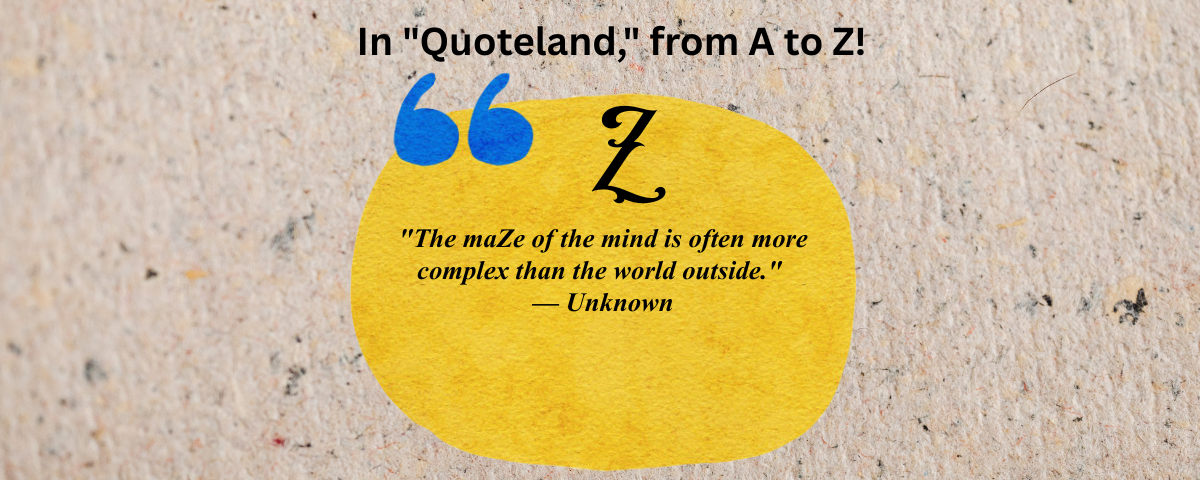
maZe
28th April 2026
The human experience is often defined by a strange paradox: we spend our lives navigating a physical
world of immense scale, yet the most intricate terrain we will ever encounter lies within the few
inches between our ears. The "world outside" is governed by the laws of physics, geography, and
biology—predictable systems that can be mapped and measured. The "maze of the mind," however, is a
shifting architecture of memory, emotion, and subconscious bias, making it a far more daunting
landscape to master.
Unlike a physical labyrinth with fixed stone walls, the mind’s maze is fluid. It is constructed from
years of accumulated experiences, cultural conditioning, and inherited narratives.
In the outside world, a mountain remains a mountain regardless of our mood. In the mind, a small
setback can be magnified into an insurmountable peak, or a significant achievement can be minimized
into a shallow valley. This internal distortion is what makes the mind so complex; we are not just
navigating a path, we are simultaneously the architect of the walls and the prisoner trying to find
the exit.
One of the primary reasons the mental maze outmatches the complexity of the external world is the
presence of the subconscious. While we can see the obstacles in our physical path—a literal fallen
tree or a closed door—our mental obstacles are often invisible.
We are frequently driven by "hoofbeats" of thought that we cannot identify. We might find ourselves
repeatedly choosing paths that lead to the same dead ends in relationships or career goals, unaware
that our internal map is outdated. These "shadow walls" are built from old fears and "occasional"
failures that we have mistakenly allowed to become permanent fixtures of our mental geography.
The external world is a shared reality, but the internal maze is strictly solitary. Two people can
stand in the same quiet garden, yet one may be experiencing a "Zen-like" peace while the other is
lost in a frantic, winding corridor of anxiety.
The complexity arises from the fact that our mind does not just record the world; it interprets it.
Every external event is filtered through a complex web of "Z-words"—zeal, zeroed-in focus, or
zigzagging logic—that colors our perception. Because the mind can create infinite "what-if"
scenarios, it can generate more complexity in a single hour of overthinking than the physical world
can manifest in a year.
If the mind is a maze more complex than the world, the goal of a conscious life is not to find a way
out, but to become a better cartographer. Through reflection, we begin to identify the recurring
patterns—the "horses" of our thought processes—rather than being distracted by the "zebras" of rare
and unlikely anxieties.
Ultimately, the mastery of the external world—the pursuit of titles, possessions, and travels—is a
hollow endeavor if one remains a stranger to one's own internal landscape. By choosing to observe
our thoughts repeatedly and with intention, we begin to understand the design of our own maze. We
realize that while we may never fully "solve" the mind, we can learn to walk its halls with a sense
of curiosity rather than fear, finding that the complexity we once feared is actually the very thing
that makes the human experience so profoundly rich.
This post is a part of Blogchatter A2Z Challenge 2026.
Comments