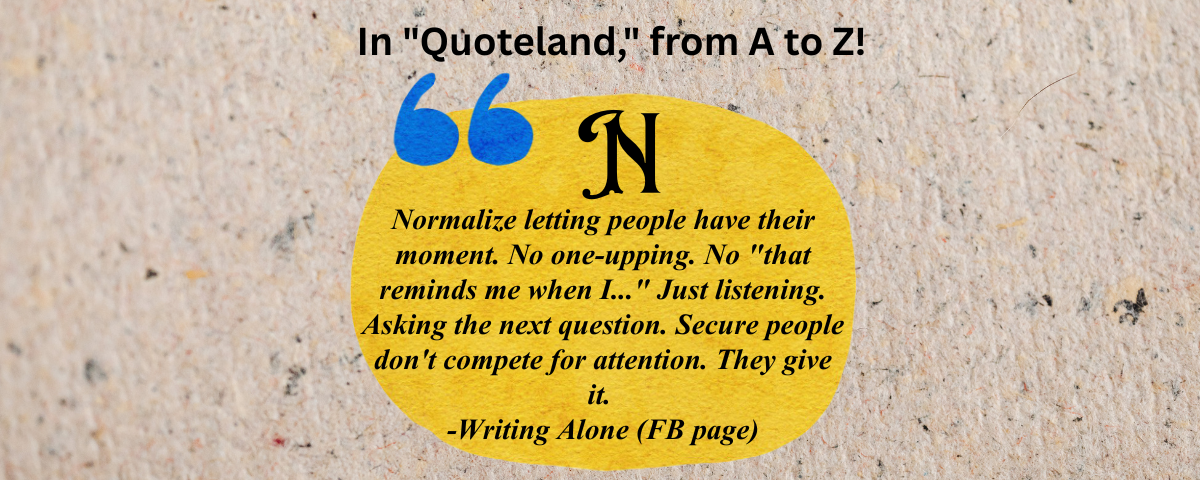
Normalize
16th April 2026
When was the last time you expressed yourself and were not interrupted by an even worse situation
faced by someone?
In an era defined by the curated performance of selfhood, conversation has frequently morphed into a
competitive sport. We live in a landscape where attention is a scarce currency, and the reflexive
impulse to "spend" it on ourselves—to interject, to pivot, or to seize the spotlight—is often
mistaken for engagement. However, there is a profound, quiet strength in the act of restraint.
Normalizing the ability to let others hold their moment without interruption or comparison is not
merely a social courtesy; it is the hallmark of genuine emotional security.
The impulse to "one-up" or redirect a conversation often stems from a place of insecurity, however
subconscious. When someone shares a triumph or a tragedy, the urge to bridge that experience with
our own—to say, "That reminds me of when I..."—is often a veiled attempt to validate our own
relevance. We fear that by remaining silent, we become invisible. We operate under the flawed
assumption that to be a conversational partner, we must be a mirror, reflecting our own history back
at the speaker rather than serving as a vessel for theirs.
True emotional security, conversely, is marked by the ability to sit comfortably in the background.
It is the confidence to realize that we do not need to prove our worth through our experiences. When
we allow someone to fully inhabit their moment, we are providing them with a rare gift: the feeling
of being truly seen. We stop listening with the intent to reply and begin listening with the intent
to understand
This shift changes the geometry of the connection. Instead of a series of parallel monologues where
each person waits for their turn to speak, the conversation becomes a collaborative exploration. By
simply asking the next question—one that draws out more of their perspective rather than pivoting to
our own—we honor the speaker’s narrative arc. We signal that their experience is sufficient,
complex, and worthy of undivided focus.
This practice requires a deliberate shedding of ego. It asks us to suppress the dopamine hit that
comes from center-stage validation and replace it with the deeper, more sustainable satisfaction of
fostering growth in another. It recognizes that relationships are not arenas for status but
environments for mutual development. When we give attention freely, we create a space where the
other person feels safe enough to be authentic. In turn, they are likely to offer us that same space
when our time comes to share.
Ultimately, the most secure people are those who understand that they do not need to compete for the
spotlight because they are comfortable with who they are in the dark. They have learned that
connection is not found in the volume of our anecdotes, but in the depth of our presence. To listen
without reservation, to resist the urge to compare, and to ask the next question is to participate
in the highest form of human connection. It is the realization that by letting others have their
moment, we do not lose our own—we only gain a more meaningful place in theirs.
This post is a part of Blogchatter A2Z Challenge 2026.
Comments