Perspective
18th April 2026
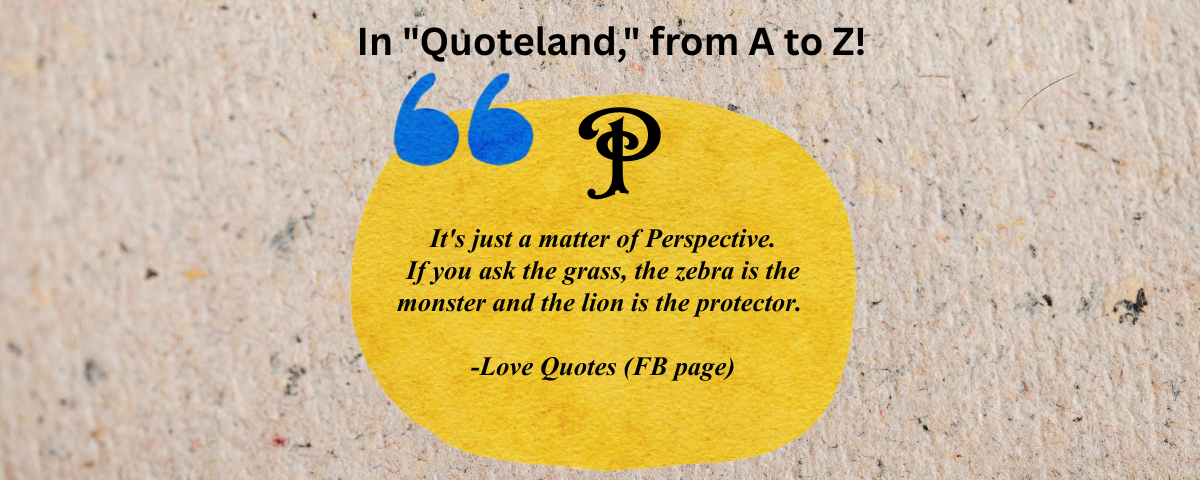
We are socially conditioned to view the lion as the apex predator—the "villain" of the savannah—and
the zebra as the innocent victim. However, by shifting the point of view to the grass, the moral
landscape flips entirely. This metaphor serves as a powerful entry point into a broader
philosophical truth: Truth is rarely an objective monolith; it is a prism shaped by one's
position,
needs, and survival.
In the human experience, we often categorize people and actions into binary boxes of "good" and
"evil." We view the protector as the one who guards our interests and the monster as the one who
threatens them. However, this quote suggests that "monster" and "protector" are not inherent
identities but functional labels assigned by the observer.
For the grass, the zebra represents an existential threat—a relentless consumer that ends its life.
The lion, by hunting the zebra, inadvertently ensures the grass's survival. The lion does not intend
to be a hero; it is merely fulfilling its nature. Yet, to the grass, the lion’s hunger is a saving
grace. This reminds us that one person's "liberator" is often another's "oppressor," depending
entirely on whose "turf" is being trampled.
The quote also highlights the inevitable conflict inherent in a diverse world. Life is not a series
of harmonious coincidences; it is a complex web of competing needs.
The Zebra must eat to survive.
The Grass must grow to exist.
The Lion must hunt to live.
None of these entities is "wrong" in their actions, yet their survival requirements are mutually
exclusive. This translates deeply into human sociology, economics, and politics. A policy that
"protects" one industry might be the "monster" that destroys another. Recognizing this doesn't
necessarily make a decision easier. Still, it does foster a necessary empathy—a realization that the
"villain" in our story is simply the "hero" of their own survival.
Perhaps the most profound takeaway is the fragility of objective truth. We often believe our
perspective is the "correct" one because it is the only one we inhabit. The grass's reality is just
as valid as the zebra’s, yet they are opposed.
If we apply this to modern discourse, it encourages a radical shift in how we approach conflict.
Before condemning the "monster," we must ask: "Whose grass am I standing on?" By acknowledging that
our own needs and vantage point limit our perspective, we move away from judgmental certainty and
toward a more nuanced understanding of the world.
The grass, the zebra, and the lion are all part of the same ecosystem, yet they live in different
moral universes. The quote challenges us to step out of our own shoes and realize that the world
does not revolve around a single narrative. To understand the "monster," you must first understand
what it is trying to survive; to thank the "protector," you must first acknowledge who they had to
devour to keep you safe. Ultimately, wisdom lies not in picking a side but in recognizing the
validity of the entire circle.
This post is a part of Blogchatter A2Z Challenge 2026.
Comments