The Unwritten Script
18th September 2026
The brass bell at the threshold never rang; it was struck.
Every evening at seven, the iron gate clicked, followed by two firm, metallic thuds on the front door. That was the signal. Without a word, Aarav’s mother would leave the kitchen, lower the flame under the simmering dal, and wipe her hands on her pallu. Aarav, seven years old, would instantly lower the volume on the television and push his toys under the wooden sofa.
His father, Ramesh, entered like a change in atmospheric pressure.
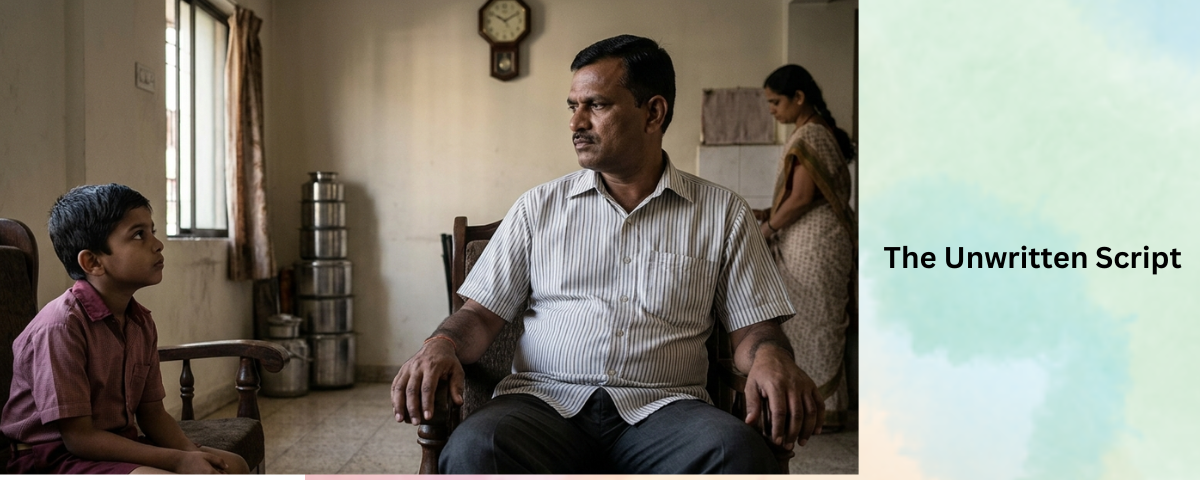
He didn't yell. He didn't have to. Authority in the Sharma household was not expressed through noise, but through a suffocating, heavy silence that demanded absolute compliance. Ramesh threw his briefcase onto the dining table. A paper fell out.
"Why is the fan in the corridor running?" Ramesh asked, his voice flat, untroubled, and absolute.
"I was cleaning there just a minute ago—" his mother started, her hands instinctively folding in front of her.
"I asked a question, Sunita. I didn't ask for a narration."
Sunita quieted instantly, switching off the fan and rushing to bring a glass of cold water. Ramesh drank half, handed the glass back without looking at her, and walked into the bedroom. Aarav watched from the corner of the living room. He didn't feel afraid; he felt a quiet, emerging awe. His father was the sun around which their tiny universe rotated. What his father said was law. When his father was pleased, the house breathed; when he was crossed, the air grew thin.
Aarav learned the grammar of his home early: Men command the space; women manage the discomfort.
At twenty-six, Aarav was a successful software engineer in Pune. He was composed, well-spoken, and respected at work. When he married Ananya, a bright, articulate graphic designer, his family praised the match. "He is just like his father," his aunts would say proudly at the reception. "Grounded. Responsible. A real man."
Aarav took that as the highest compliment.
In the first few months of marriage, the rhythm of their apartment was gentle. But slowly, imperceptibly, the old blueprints began to unfold. It wasn't physical violence or loud, dramatic fights. It was subtler—a quiet, systematic calibration of power.
It began with small things.
"Ananya, why are these shoes kept near the entry?" Aarav asked one evening after a long day at the office.
Ananya looked up from her laptop, where she was finishing a client deck. "Oh, sorry! I came in in a rush with the groceries. I'll move them in a bit."
Aarav stood over the coffee table, his shadow falling across her screen. He didn't raise his voice. He used the exact, flat tone his father had perfected over three decades. "It takes two seconds to put them away. Why leave a mess for later?"
Ananya paused, caught off guard by the edge in her voice. "I said I'd do it in a bit, Aarav. I'm right in the middle of a deadline."
Aarav folded his arms. "Work shouldn't mean the house falls apart. My mother managed a full household without leaving things lying around."
The words slipped out of him effortlessly, as natural as breathing. Ananya stared at him, hurt and confused, before closing her laptop without a word and moving the shoes. Aarav felt a brief surge of order restored. In his mind, he wasn't being mean; he was maintaining discipline. He was being the anchor of the house.
Months turned into years, and the patterns solidified into concrete.
When Ananya wanted to apply for a promotion that required occasional late-night calls with international clients, Aarav dismissed it over breakfast. "It's not practical, Ananya. Who will manage dinner? My schedule is unpredictable as it is."
"We can hire help for cooking, Aarav," she reasoned, her voice tight. "This is a big step for my career."
"I don't want outside cooks in our kitchen every day," he said calmly, taking a sip of his tea. "A family needs stability. I earn enough for both of us. There’s no need to strain yourself."
He frame it as protection, as care. But behind the gentle phrasing was an unyielding wall. When she tried to argue, he simply withdrew. He would ignore her texts, answer her questions in monosyllables, and walk around the apartment as if she were made of glass.
He watched her wilt under the cold shoulder, just as his mother used to. And like his mother, Ananya eventually stopped arguing. She began apologizing for things that weren't her fault. She started adjusting her life around his moods, watching the door at seven evening, checking if the house was quiet enough, perfect enough, silent enough.
One Sunday, Ramesh and Sunita visited them for lunch.
The dining table was laden with dishes. Ananya had spent the entire morning cooking, her eyes tired, her shoulders tense. As they sat down, Aarav noticed a slight burn on the edges of the parathas.
Before he could speak, his father picked up a piece, looked at it, and laid it back down on his plate. Ramesh didn't say anything. He just pushed the plate an inch away and reached for the rice instead.
Sunita immediately looked at Ananya with a sympathetic, apologetic wince.
Aarav looked at Ananya. She was sitting stiffly, her eyes fixed on her hands in her lap, her throat working silently as she swallowed back tears.
In that split second, a bizarre sensation washed over Aarav. He looked at his father—aging, grey-haired, sitting in quiet, unquestioned supremacy. Then he looked at himself in the mirror across the dining room. He saw his own rigid posture, his set jaw, the slight frown he carried as a permanent uniform.
He saw the exact same shadow falling over Ananya that had draped over his mother for thirty years.
"Ananya," Aarav said softly.
She flinched slightly, expecting the critique.
Aarav reached out to pick up a paratha. His hand hovered in the air. The script was right there in his head, written decades ago, ready to be recited: You should have paid more attention. It felt safe. It felt natural. It was everything he had ever known a head of the household to be.
He looked at Ananya’s knuckles, white from gripping her napkin. He saw not a partner, but a captive in a routine he had inherited and executed with flawless precision.
Aarav took the paratha and put it on his plate. "The food is great," he said, his voice cracking slightly under the weight of an unfamiliar effort. "Thank you."
Ramesh looked up, a faint flicker of disapproval in his eyes at the breakdown of unspoken protocol. Ananya looked up too, cautious, her eyes searching his face for a catch, unable to believe the spell had broken—even if only for a second.
Aarav chewed in silence. The inheritance was deep, woven into his very bones, but as he looked around the quiet table, he realized for the first time that the house he was building felt less like a home, and more like a cage.
This post is a part of
Blogchatter Half Marathon.
Comments