Vulnerability
24th April 2026
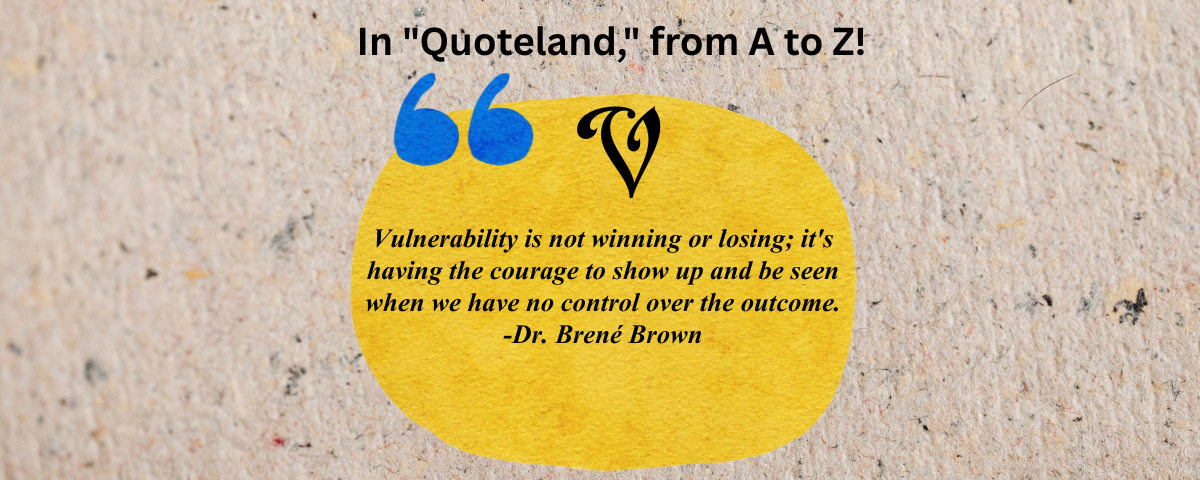
The quote, "Vulnerability is not winning or losing; it's having the courage to show up and be
seen
when we have no control over the outcome," popularized by researcher Brené Brown, challenges the
traditional cultural narrative that equates vulnerability with weakness. In a society that often
demands certainty and perfection, vulnerability is frequently misidentified as a lack of emotional
armor. However, a deeper examination reveals that vulnerability is the very definition of
courage—the willingness to engage with life and others without the guarantee of a specific result.
For many, the word "vulnerability" evokes images of helplessness or emotional exposure that leads to
harm. This misunderstanding stems from a competitive worldview where "winning" is the only metric of
success. In this framework, showing one’s true self is seen as giving others a weapon to use against
you.
Yet, to live without vulnerability is to live in a state of constant "armoring." We build walls of
perfectionism, cynicism, or emotional distance to protect ourselves from the possibility of being
judged or rejected. While these walls may keep out pain, they also block the light of genuine
connection. As the quote suggests, vulnerability isn't about the score at the end of the game; it is
the act of stepping onto the field in the first place.
The core of vulnerability is the act of showing up. This applies to every meaningful facet of human
existence:
In Relationships: It is telling someone you love them first, without knowing if they love you
back.
In Creativity: It is sharing a story, a poem, or an idea with the world, knowing it might be
criticized or ignored.
In Leadership: It is admitting you don’t have all the answers and asking for help.
In each of these scenarios, the individual has "no control over the outcome." The "win" isn't the
positive response; the "win" is the internal triumph of bravery over the fear of being seen. When we
show up, we are essentially saying, "This is who I am, and this is what I care about," regardless of
how the world reacts.
Human beings have a fundamental desire for control. We plan, we predict, and we rehearse to minimize
the risk of failure. However, the most transformative experiences in life—falling in love, grieving
a loss, or undergoing personal growth—are precisely those where we have the least control.
Vulnerability requires a radical acceptance of uncertainty. It is the realization that we cannot
"engineer" a perfect life. When we stop trying to control the outcome, we free ourselves to be
present in the process. This presence is where true innovation and intimacy reside. By letting go of
the need to be certain, we open the door to being authentic.
True connection is impossible without vulnerability. If we only show the "winning" versions of
ourselves—the filtered photos, the professional achievements, the composed exterior—we are merely
presenting a facade. Facades cannot be loved; only people can be loved.
When we have the courage to be seen in our messiness, our doubts, and our aspirations, we give
others permission to do the same. This shared vulnerability creates a "common ground" of humanity.
It is the bridge that turns strangers into friends and colleagues into teammates.
Vulnerability is not a state of being "broken"; it is the ultimate expression of being "whole." It
is the refusal to let the fear of a negative outcome dictate the boundaries of our lives. By
redefining vulnerability as the courage to be seen, we shift our focus from the scoreboard of life
to the quality of our engagement with it. In the end, the most courageous thing any of us can do is
to step out of the shadows of our own defenses and stand in the light of our own truth.
This post is a part of Blogchatter A2Z Challenge 2026.
Comments