What She Thought Was Normal
17th September 2026
When Meera was six, she learned that some touches came without
permission.
An uncle hugged her long after she tried to pull away.
A cousin touched her in ways that made her uncomfortable.
A family friend would place his hands on her and tell her not to be
“so shy.”
Each time, Meera looked toward the adults, waiting for someone to
notice.
No one did.
And when she finally found the courage to say something, her mother
frowned.
“Don't make a fuss. He's family.”
Someone laughed.
Someone told her she was imagining things.
Someone said, “Good girls don't create problems.”
So Meera learned the first rule of her childhood:
Her discomfort was less important than everyone else's
comfort.
She stopped speaking.
Then she stopped resisting.
By fifteen, she had learned to freeze when someone crossed a
boundary.
By eighteen, she had learned something even more dangerous—
not to recognize the boundary at all.
When boys began showing interest in her, she mistook jealousy for
love.
A hand that wouldn't move when she asked it to become
“affection.”
Possessiveness became “caring.”
Being told what to wear, where to go and whom to speak to became “he
really likes you.”
Whenever something inside her whispered this doesn't feel right,
another voice answered:
This is how men are.
So, when her friend Rhea pushed a boy's hand away and complained
that he had crossed a line, Meera laughed.
“Relax. You're overthinking it.”
Rhea stared at her.
“You're okay with this?”
Meera shrugged.
“It's normal.”
She didn't realize she had just become the voice that had silenced
her six-year-old self.
Years passed.
Meera became a teacher.
She was good at her job. Children trusted her. They came to her with
scraped knees, broken pencils, secret worries and stories they were
too embarrassed to tell anyone else.
Then, one afternoon, seven-year-old Tara waited until the classroom
had emptied.
“Ma'am?”
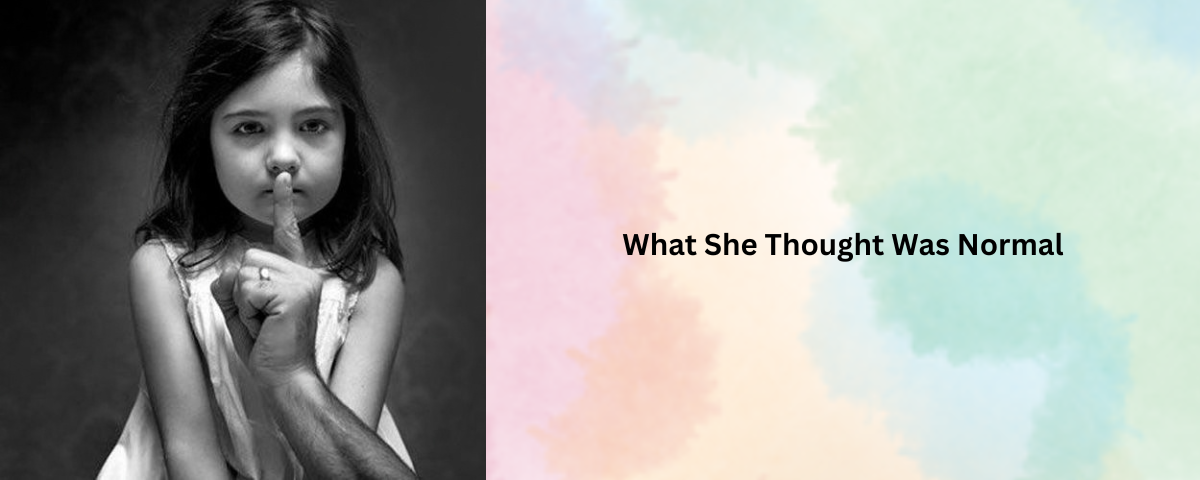
Meera looked up.
Tara was standing by the door, twisting the edge of her uniform
between her fingers.
“Someone touches me in a way I don't like.”
The room suddenly felt very small.
Meera's hands went cold.
For a moment, she wasn't a teacher.
She was six years old.
Standing in a room full of adults.
Waiting for someone to tell her that what was happening wasn't
okay.
She swallowed.
Then she walked over to Tara and knelt beside her.
“Did you want him to touch you?”
Tara shook her head.
“Did you say no?”
Another shake.
Meera's voice trembled, but she kept it steady.
“Then it isn't okay.”
Tara looked at her.
“Even if he's someone we know?”
Meera felt something inside her break—and, somehow, begin to
mend.
“Especially then. Knowing someone doesn't give them permission to
touch you.”
That evening, Meera sat alone in her classroom long after the
children had gone.
For the first time, she allowed herself to remember.
The hands.
The fear.
The silence.
The adults who had looked away.
The little girl who had slowly learned that her discomfort didn't
matter.
And finally, the truth she had spent years avoiding:
What happened to her had never been normal.
It had only been repeated so often that she had stopped calling it
wrong.
She had mistaken control for love.
Silence for consent.
Fear for affection.
And violation for something she simply had to tolerate.
Meera wiped her tears.
She couldn't go back and protect the six-year-old girl she had
been.
But there were other six-year-olds.
Other children standing at doors, twisting their sleeves, searching
adults' faces for permission to trust their own discomfort.
The next morning, Tara came into class.
Meera smiled at her.
And silently made herself a promise:
She would teach children what nobody had taught her.
Your body belongs to you.
Your “no” does not need to be explained.
Your discomfort is enough reason to speak.
And most importantly—
Love never asks you to surrender your boundaries.
This post is a part of
Blogchatter Half Marathon.
Comments